Xeriscape vs. Traditional Landscape in the Okanagan
Xeriscaping costs more upfront than a traditional lawn-and-bed landscape but needs far less water and far less season-to-season upkeep once it’s established — a real advantage in a valley that sits in a semi-arid climate zone and sees watering restrictions most summers. A traditional landscape is cheaper to install and familiar in appearance, but it’s the thirstier, higher-maintenance choice over the long run.
What Each Approach Actually Looks Like
A traditional Okanagan landscape is built around a lawn: an irrigated grass area, foundation planting beds along the house, and a mix of ornamental shrubs and perennials that generally aren’t chosen for drought tolerance. It’s the default because it’s familiar, it’s flexible for kids and pets, and most people already know how to maintain it.
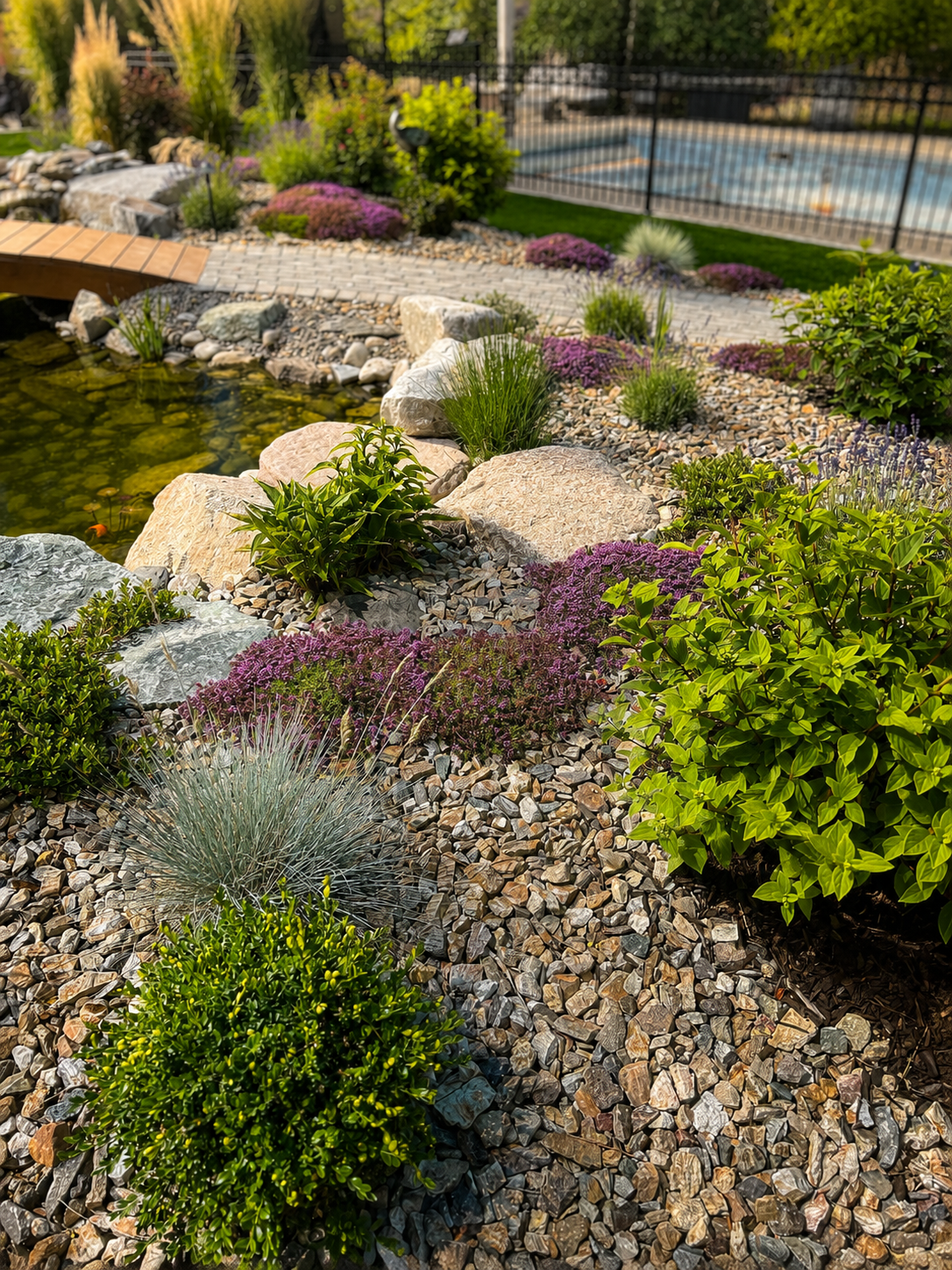
Xeriscaping isn’t “no plants” — it’s a designed landscape built around drought-tolerant and native or adapted species, grouped by water need, with reduced turf area, mulched or gravel beds, and often boulders, dry creek beds, or hardscape used in place of grass. A well-designed xeriscape can be just as lush-looking as a traditional yard; the difference is in what’s chosen and how it’s laid out, not in how green or how sparse the result looks.
Upfront Cost
Xeriscaping runs $12,000–$75,000+ total, depending on scope: $18–25/sq ft for a basic conversion of existing turf, $25–35/sq ft for a complete installation, and $35–45+/sq ft for a premium design with boulders, lighting, and mature plants. A traditional lawn-and-bed landscape is typically cheaper per square foot to install initially, mainly because sod and basic irrigation are less labor- and material-intensive than grading, soil prep, boulder placement, and structured planting beds. These are early budget ranges, not formal quotes — final pricing depends on site access, existing conditions, excavation, grading, drainage, material selections, engineering, permits, and the final approved design. Limited access adds +10–20%, removing existing material (like an existing lawn) adds +10–25%, and moderate slope adds +10–20%.
Water Use Over Time
This is where the comparison flips. A traditional lawn is the highest water-demand element in most residential landscapes — it needs frequent irrigation through the entire growing season to stay green, and that demand climbs during hot, dry stretches, which is exactly when Okanagan municipalities are most likely to impose watering restrictions. A xeriscape is designed to need meaningfully less irrigation once plants are established, because the plant palette is chosen for the region’s natural rainfall pattern rather than fighting against it. We won’t put a number on exactly how much water either approach uses, since that depends heavily on plant selection, irrigation system, bed size, and the specific season — but the general direction is well established: less turf and more drought-adapted planting means less water demand, full stop.
Maintenance
A traditional lawn needs regular mowing, edging, fertilizing, and consistent irrigation to look good through the season, along with the seasonal work of aerating, overseeding, and dealing with weeds in turf. A xeriscape’s maintenance load shifts: less mowing (or none, if turf area is minimal), less frequent watering once plants are established, but still real seasonal work — pruning, occasional weeding in mulched beds, and monitoring young plants until their root systems mature enough to handle Okanagan summers on their own. Xeriscaping reduces maintenance, it doesn’t eliminate it, and a good design accounts for that transition period rather than assuming zero care from day one.
Appearance Trade-Offs
The biggest misconception is that xeriscaping means gravel and cactus. In practice, a well-designed xeriscape in the Okanagan can be visually rich — layered plantings, seasonal color, texture from ornamental grasses and boulders, and structure from evergreens — it just won’t look like a flat, uniform lawn. Some homeowners genuinely prefer the softer, more casual look and functional flexibility of a traditional lawn, especially if the yard gets heavy use for kids, pets, or entertaining on open grass. That’s a legitimate reason to keep some traditional lawn area even in an otherwise xeriscaped property; the two approaches aren’t strictly all-or-nothing, and a hybrid design that keeps a smaller functional lawn while converting the rest is a common and practical middle ground.
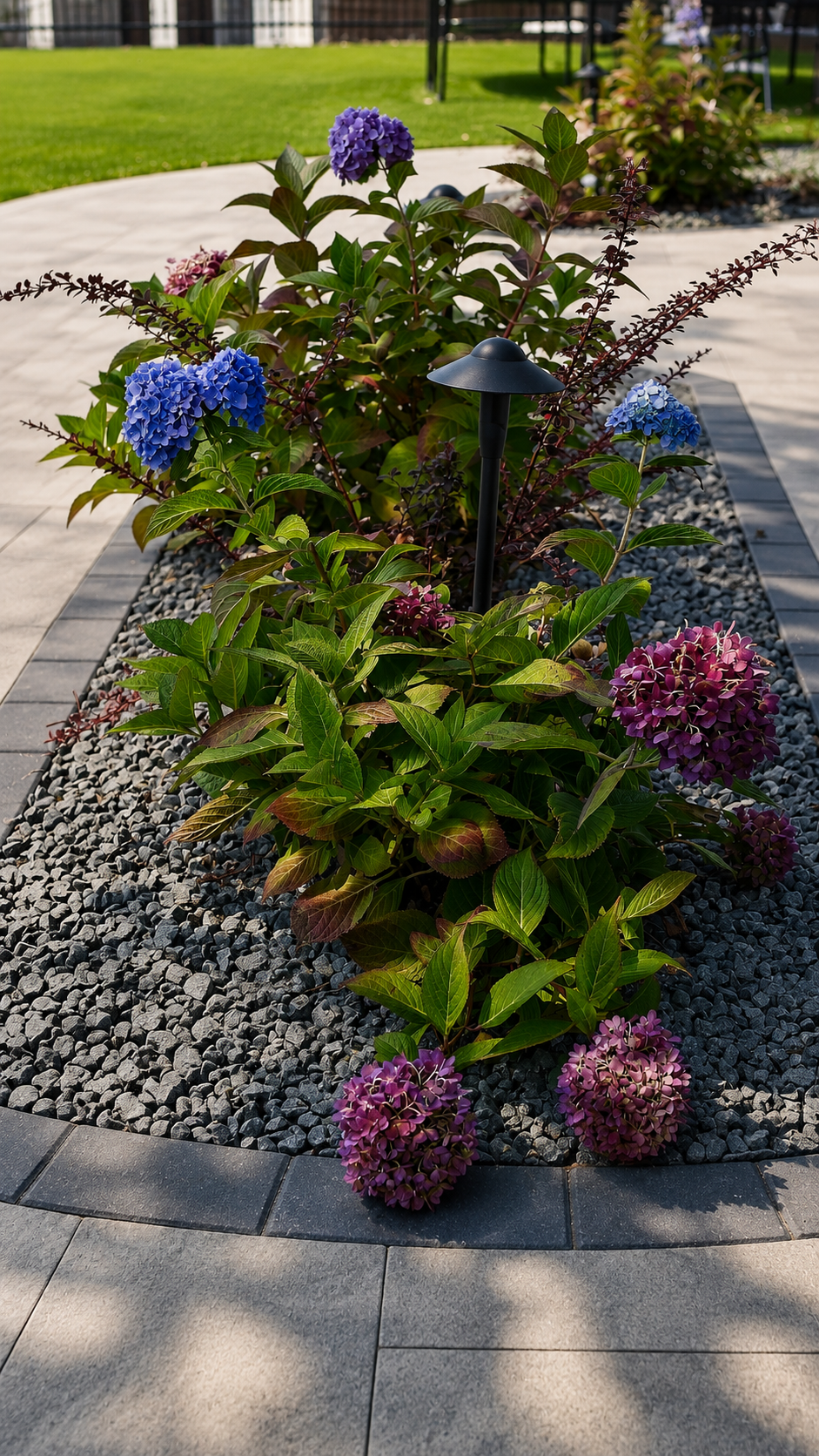
A finished planting bed by Kalagan Outdoor Design
Okanagan-Specific Factors for Planting & Xeriscape Design
The Okanagan Valley sits in one of the driest, most semi-arid climate zones in the country, with hot, low-rainfall summers that put real pressure on any landscape built around thirsty turf. Vernon and neighboring municipalities regularly introduce lawn watering restrictions during peak summer months, which means a traditional lawn’s water needs and the region’s water supply rules are frequently in direct tension — a xeriscape sidesteps that conflict by design rather than by rationing. Hardiness and exposure also matter here: south- and west-facing slopes bake hard in summer sun, and a xeriscape’s drought-adapted plant choices tend to handle that exposure far better than conventional lawn grass or non-adapted ornamentals. For properties in wildfire-interface areas, a well-planned xeriscape can also support defensible-space goals, since reduced turf and well-spaced, well-maintained drought-tolerant plantings generally carry less fuel load than an unmaintained lawn edge or overgrown bed — though FireSmart defensive landscaping is its own distinct service with its own design requirements, not something a standard xeriscape automatically satisfies.
See the full Xeriscaping & Planting Design service page for plant palette options, design process, and next steps. If you’re weighing a hybrid yard that keeps some traditional lawn, our Artificial Turf vs. Sod for BC Lawns guide covers a related low-water alternative to grass. And if hardscape is part of your xeriscape plan, Pavers vs. Concrete for Okanagan Patios covers the material trade-offs for the paved areas that often replace turf in a xeriscape design.
Ready to Get a More Accurate Estimate?
Tell us about your yard and we’ll help you figure out how much of it makes sense to xeriscape.
Get a More Accurate Project Estimate → Book a Consultation