Artificial Turf vs. Sod for BC Lawns
Artificial turf costs more upfront ($15-25/sq ft installed) but eliminates watering, mowing, and reseeding for good. Sod costs far less to install but carries ongoing water, fertilizer, and mowing costs for as long as you keep it. In the Okanagan’s dry summers, turf usually wins on total cost of ownership within 5-8 years — but the right choice depends on your budget, your yard’s use, and how much you value a natural lawn.
Cost: Upfront vs. Lifetime
Sod is inexpensive to install compared to turf — typically a few dollars per square foot for material and installation, depending on grading and soil prep. But that low sticker price doesn’t reflect what a lawn actually costs over time: irrigation system installation and repairs, a summer’s worth of water use, fertilizer, weed control, and either your own mowing time or a contractor’s invoice, year after year.
Artificial turf runs $15-25/sq ft for most residential projects, with total project costs typically landing in the $8,000-$50,000+ range depending on yard size. Standard turf installations run $15-19/sq ft, premium turf (denser pile, more realistic blade shapes, better UV-stabilized backing) runs $19-23/sq ft, and pet-friendly or difficult-access installs — extra base preparation, drainage layers, antimicrobial infill — run $23-28+/sq ft. Once it’s in, there’s no water bill increase, no mowing, and no reseeding. Turf typically holds up 15-20 years before it needs replacing.
These are early budget ranges, not formal quotes — final pricing depends on site access, existing conditions, excavation, grading, drainage, material selections, and the final approved design. Universal cost adjustments also apply: limited access adds 10-20%, very difficult or hand-access sites add 20-35%, removing existing lawn or hardscape adds 10-25%, and moderate slope adds 10-20% (steep slope requires a site consultation). All prices are CAD and exclude GST.
Appearance Year-Round
Sod looks best in spring and early summer with consistent watering. Through an Okanagan July and August, an unwatered or lightly-watered lawn typically goes dormant and turns brown — a normal, recoverable survival response for most grass species, but not the lush green look most homeowners want from their front yard. Watering enough to keep sod green through a hot, dry Okanagan summer means a real and ongoing commitment to irrigation.
Artificial turf looks the same in January and August. There’s no dormancy, no brown patches from heat stress, and no muddy season in spring thaw. The trade-off is that turf doesn’t have the texture or subtle color variation of a living lawn, and on very hot, direct-sun surfaces it can get warmer to the touch than natural grass — something to factor in for play areas.
Durability for Pets and Kids
Sod handles moderate foot traffic well but shows wear in high-use zones — worn paths, bare patches near gates or play equipment, and digging damage from dogs. It recovers over a season if traffic eases up, but heavy year-round use keeps it patchy.
Turf handles concentrated pet and kid traffic without wearing bare, since there’s no living root system to damage. Pet-friendly turf specifications add proper drainage and antimicrobial infill so it doesn’t hold odor the way a standard install might. It also removes the mud problem entirely — no muddy paw prints or grass stains tracked inside after a wet week.
Water Use
This is the sharpest contrast between the two. A natural lawn in the Okanagan’s semi-arid climate needs consistent irrigation through the growing season to stay green, and that demand peaks exactly when regional water restrictions are most likely to be in effect. Artificial turf uses zero irrigation water after installation. If reducing outdoor water use is a priority — for your utility bill, for a well or limited water source, or simply for a lower-maintenance yard — turf removes the issue entirely rather than managing around it.
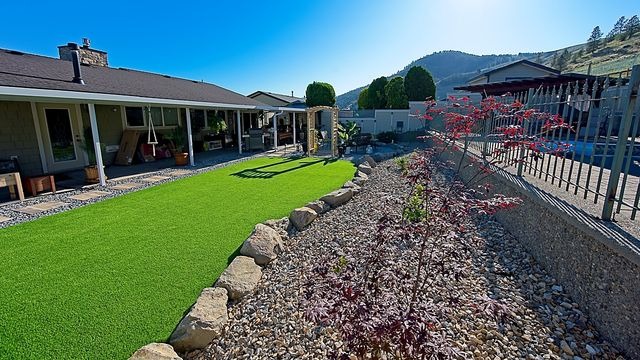
A finished artificial turf installation by Kalagan Outdoor Design
Okanagan-Specific Factors for Artificial Turf
Vernon and the wider Okanagan sit in one of the driest, warmest climates in BC, with hot, low-rainfall summers that put real stress on natural lawns and put water restrictions in play most years — exactly when a green lawn needs the most irrigation. That’s the single biggest reason turf pencils out well here: it sidesteps the water-use question rather than fighting it. Freeze-thaw cycles through winter affect both options less than hardscaping, but proper base preparation still matters for turf so it drains well and doesn’t heave with frost. On sloped Okanagan lots, both sod and turf need correct grading and drainage planning before installation — turf especially, since a poorly-drained base can trap water underneath the surface. Kalagan doesn’t offer ongoing landscape maintenance, so this comparison is about the install and the years of upkeep (or lack of it) that follow — not a maintenance plan for either option.
Explore Kalagan’s Artificial Turf service for full installation details and specifications. If you’re weighing other material trade-offs on the same property, see Pavers vs. Concrete for Okanagan Patios and Paver Patio vs. Natural Stone Patio: Which Is Right for You. Planning a full yard renovation? Block vs. Natural Stone Retaining Walls covers another common decision point for Okanagan properties.
Ready to Get a More Accurate Estimate?
Tell us about your yard and we’ll help you figure out whether turf or a fresh lawn makes more sense for your budget and how you use the space.
Get a More Accurate Project Estimate → Book a Consultation