Best Evergreens for Natural Privacy in BC
Emerald cedar (Thuja occidentalis ‘Smaragd’) is the go-to living screen for most Okanagan yards, but it is not the only option — boxwood, yew, and native western red cedar all have a place depending on your space, soil, and deer pressure. This guide breaks down the real trade-offs so you can pick a species that will actually thrive here, not just look good on a nursery tag.
Evergreen Screening Options for the Okanagan
A privacy planting only works if the species you choose actually survives an Okanagan winter, tolerates our soil, and grows into the form you’re picturing. Here are the evergreens we see perform consistently well as living screens in Vernon, Kelowna, and the surrounding Okanagan Valley.
Emerald Cedar (Thuja occidentalis ‘Smaragd’)
The most commonly planted privacy hedge in the Okanagan, and for good reason. Emerald cedar grows in a tight, naturally columnar form that needs little to no shearing to stay narrow — useful on tighter side yards where a spreading hedge would eat too much space. Expect roughly 8-12 inches of growth per year once established, reaching 12-14 feet at maturity with a spread of only 3-4 feet. It holds its rich green color through winter (unlike some cedar cultivars that bronze in cold snaps) and is rated hardy to USDA zone 3, comfortably within our zone 5-6a range. The main weakness: young cedars are a preferred deer browse, especially in winter when natural forage is scarce, so new plantings often need protection for the first two to three seasons.
Western Red Cedar (Thuja plicata)
BC’s native cedar and a strong choice where you have more room to let a screen grow wide and tall — it’s the plant behind most of the mature cedar hedgerows you see on older Okanagan acreages. It grows faster and larger than emerald cedar (easily 40+ feet over time, with a broader spread), so it suits larger rural or semi-rural lots better than a narrow urban side yard. It prefers consistent moisture and richer soil than our naturally dry benchlands provide, so a native cedar hedge planted away from a lawn irrigation zone will need supplemental watering, particularly through its first few summers.
Boxwood (Buxus sempervirens and hybrids)
Boxwood is a broadleaf evergreen rather than a conifer, and it gives you a very different look: dense, small-leaved, and easily kept as a clipped formal hedge in the 2-4 foot range, or left to grow taller and looser for screening at eye level. It’s genuinely deer-resistant — one of the few evergreens deer reliably leave alone — which makes it a strong pick for properties bordering greenspace or agricultural land where cedar gets browsed hard. Winter sun and wind can cause bronzing on exposed sites, so a location with some winter wind protection (or a hardier cultivar such as ‘Green Velvet’ or ‘Green Mountain’) performs best in our climate.
Upright Yew (Taxus x media ‘Hicksii’)
Yew is one of the most shade-tolerant screening evergreens available, which makes it valuable on the north side of a house or under the edge of existing tree canopy where cedar and boxwood both struggle. ‘Hicksii’ grows in a narrow, upright column similar in habit to emerald cedar and takes shearing well if you want a tighter formal line. It’s also more deer-resistant than cedar, though not entirely immune. One important note: all parts of yew except the fleshy red aril are toxic if ingested, which matters if you have grazing livestock nearby or young children who put plants in their mouths.
Spacing and Layout
For a continuous screen, plant on-center spacing at roughly 60-70% of the mature spread of the cultivar — for emerald cedar that’s typically 3-4 feet apart; for a wider-growing western red cedar hedge, 5-6 feet is more appropriate. Planting too tight forces competition for water and root space and tends to produce a thinner, less healthy screen long-term, even though it looks fuller in year one.
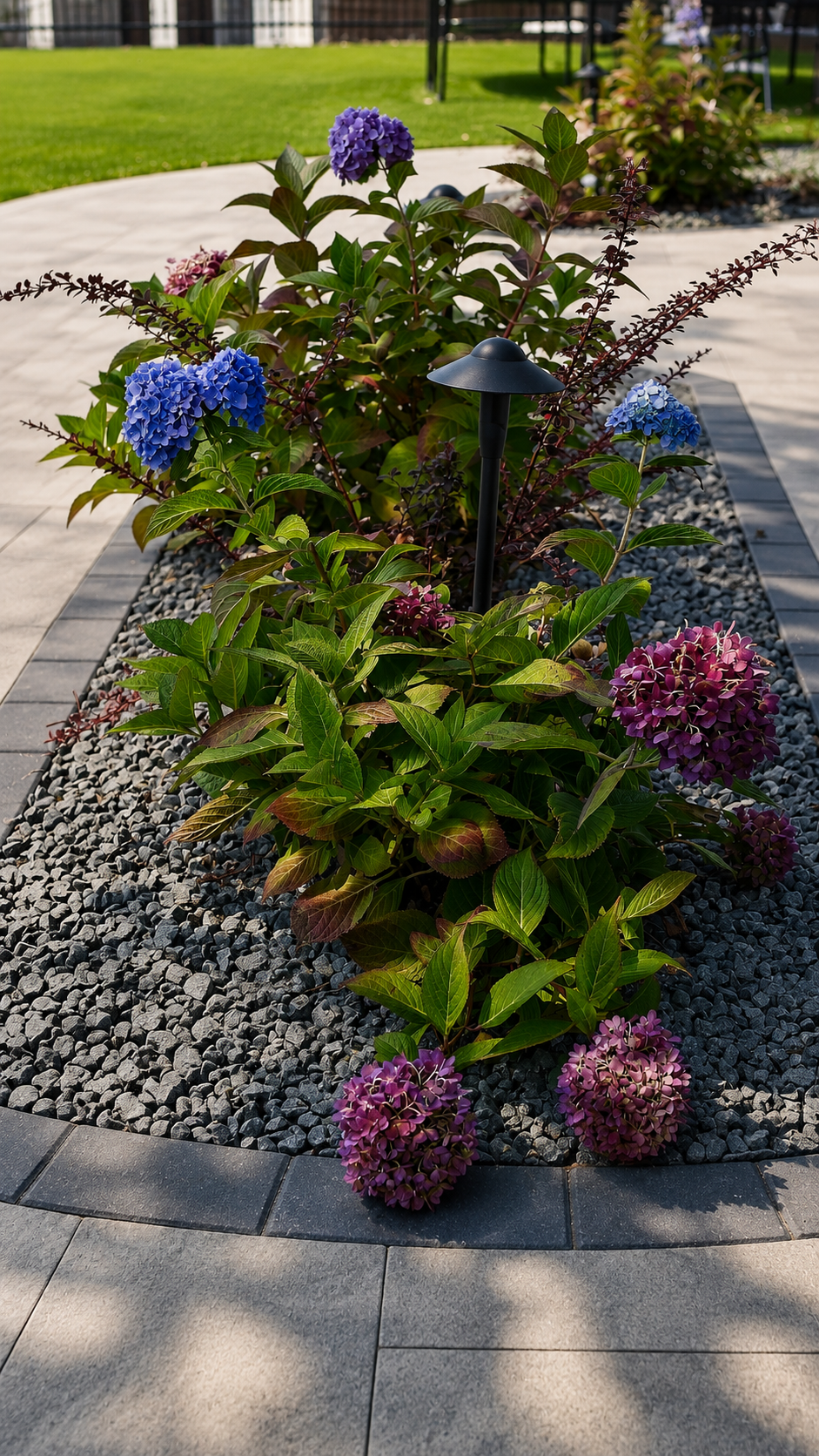
A finished planting bed by Kalagan Outdoor Design
Okanagan-Specific Factors for Planting & Xeriscape Design
The Okanagan’s semi-arid climate is the biggest factor in evergreen privacy plantings here: our low annual precipitation means every one of these species needs a deliberate irrigation plan for at least the first two to three growing seasons, even the drought-tolerant ones, until root systems are established. Winter is the second major factor — our freeze-thaw cycles and occasional deep cold snaps are hard on evergreens planted in exposed, windy locations, so siting a hedge with some protection from prevailing winter wind (or choosing a hardier cultivar) reduces winter bronzing and dieback. Deer pressure varies significantly by neighbourhood across Vernon, Kelowna, Lake Country, and West Kelowna, and it’s worth observing your own property (or asking neighbours) before committing to a cedar hedge, since a fresh planting can be stripped in a single winter in high-pressure areas. Finally, if your property sits within a wildfire interface zone, be aware that dense, closely spaced conifer hedges planted directly against a home can act as a fuel ladder; in those situations it’s worth reviewing FireSmart guidance on plant selection and defensible space before finalizing a privacy planting close to structures.
A privacy hedge is one piece of a broader planting design — see our Xeriscaping & Planting Design service page for how we integrate screening plants into a low-water, low-maintenance landscape plan. If deer are a concern on your property, pair this guide with Deer-Resistant Perennials for Vernon for the rest of the bed. And for a wider palette of natives and drought-tolerant companions to plant alongside your evergreen screen, see Zone 5 Native Shrubs for the Okanagan and 50 Drought-Tolerant Plants for the Okanagan.
Ready to Plan Your Planting Design?
Our design team can help you choose and lay out the right mix of evergreens and companion plants for your specific site, soil, and privacy needs.
Explore This Service → Book a Consultation