Ornamental Grasses for Xeriscape Design
Ornamental grasses are one of the hardest-working plant categories in a xeriscape: once established, most Okanagan-suited varieties need little more than a spring cut-back and occasional deep watering. Feather reed grass, blue fescue, little bluestem, and hardy miscanthus varieties are the workhorses for Vernon-area gardens because they tolerate our dry summers, alkaline soils, and winter freeze-thaw swings without fuss.
Why Grasses Belong in a Xeriscape
A xeriscape lives or dies on plant selection, and ornamental grasses solve several problems at once. Their fibrous, deep root systems are built to chase moisture down through soil profiles rather than sit shallow and thirsty, which is exactly the growth habit you want in the Okanagan’s dry, well-drained soils. They also fill visual gaps between structural elements — boulders, gravel mulch, dry creek beds — with movement and texture that low groundcovers and shrubs can’t provide on their own. And because most ornamental grasses go dormant and get cut back once a year, they carry almost none of the seasonal upkeep that thirstier lawn or bedding-plant alternatives demand.
Grasses That Perform in the Okanagan
Feather Reed Grass (Calamagrostis x acutiflora ‘Karl Foerster’) is the standard-bearer for prairie and interior BC xeriscapes. It grows in tight, upright clumps to about 90-150 cm with feathery seed plumes that catch light and hold their form through winter. It’s hardy to zone 4, tolerates clay or gravelly soil, and needs full sun to look its best. Because it stays vertical rather than flopping, it works well as a repeating accent along a paver pathway or retaining wall cap.
Blue Fescue (Festuca glauca) is a compact, mounding grass that tops out around 20-30 cm, prized for its steel-blue foliage. It’s extremely drought-tolerant once rooted, hardy well into zone 3, and ideal for the front of a bed, rock garden edging, or mass-planted in gravel where its colour contrasts against warm-toned boulders. It prefers sharp drainage — heavy, wet clay is its main enemy, not cold.
Little Bluestem (Schizachyrium scoparium) is a native-leaning prairie grass that turns copper-orange to burgundy in fall and holds that colour through much of the winter. Hardy to zone 3, it thrives in lean, dry soil and actually performs worse in rich, over-fertilized ground. It’s a strong choice where you want three-season interest without irrigation.
Switchgrass (Panicum virgatum), including cultivars like ‘Heavy Metal’ and ‘Shenandoah’, brings taller vertical structure (100-150 cm) with airy seed heads and good fall colour. It’s hardy to zone 3-4, tolerates both drought and occasional wet spells, and works well as a screening or backdrop planting behind lower grasses and perennials.
Cold-Hardy Miscanthus cultivars — such as Miscanthus sinensis ‘Adagio’ or ‘Morning Light’ — give a fuller, fountain-like form for larger beds. Because standard miscanthus can be borderline in colder Okanagan pockets, stick to the more cold-tolerant zone 4 cultivars and give them a sheltered, full-sun spot. They read best as a specimen or focal grass rather than mass-planted in a small bed.
Blue Oat Grass (Helictotrichon sempervirens) is another strong steel-blue option, larger than fescue at 45-60 cm, with a stiffer, more architectural clump form. It’s hardy to zone 4 and, like fescue, wants excellent drainage above all else.
Design and Placement Notes
Grasses read best in a xeriscape when they’re used in repetition rather than as single specimens scattered through a bed — three or five of the same variety planted together create the drift-and-movement effect most people picture when they think of a grass garden. Pair low mounding types like blue fescue at bed edges and along pathways, mid-height clumping grasses like feather reed grass as structural accents near hardscape, and taller varieties like switchgrass or miscanthus as a backdrop or privacy-softening planting near a property line. Leave grasses standing through winter rather than cutting them back in fall — the dried plumes and stems provide texture and habitat value through the cold months, and a single spring cut-back to a few centimetres above ground is typically all the annual maintenance they need.
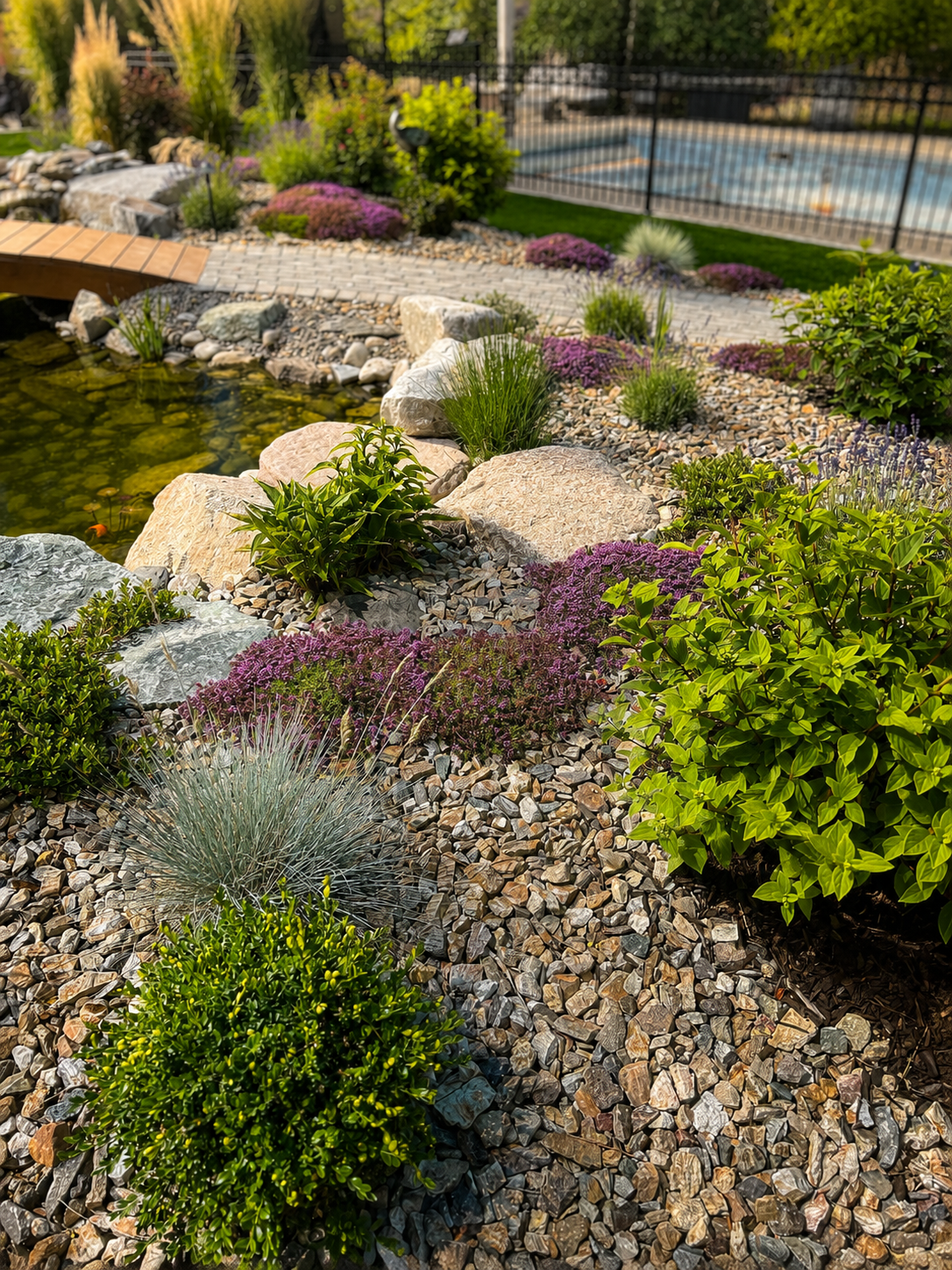
A finished planting bed by Kalagan Outdoor Design
Okanagan-Specific Factors for Planting & Xeriscape Design
Vernon and the surrounding Okanagan sit in a semi-arid interior climate with hot, dry summers, cold winters, and pronounced freeze-thaw cycling in shoulder seasons — conditions that reward grasses selected for both drought tolerance and genuine cold hardiness, not just varieties rated for milder coastal zones. Sharp drainage matters as much as hardiness rating: many grass failures we see locally come from planting into heavy clay or a low spot where winter moisture sits around the crown and freezes, rather than from the cold itself. Because the region also faces water-use restrictions during peak summer months, grasses that need only supplemental watering through their first establishment season — and little to none after — are a genuine asset for reducing irrigation demand. In properties bordering wildland areas, keep taller dried grasses back from structures and thin them as part of an annual FireSmart-conscious cleanup, since standing dry grass is fuel in wildfire-risk zones.
Ornamental grasses are usually one piece of a larger xeriscape plan — see our Xeriscaping & Planting Design service for how we combine grasses, drought-tolerant perennials, and hardscape into a full design. For companion plant selections, see 50 Drought-Tolerant Plants for the Okanagan and Zone 5 Native Shrubs for the Okanagan. If deer pressure is a concern in your area, most of the grasses above pair well with the picks in Deer-Resistant Perennials for Vernon.
Ready to Plan Your Xeriscape Planting?
Talk to our design team about which ornamental grasses and companion plants suit your site conditions, sun exposure, and water goals.
Explore This Service → Book a Consultation