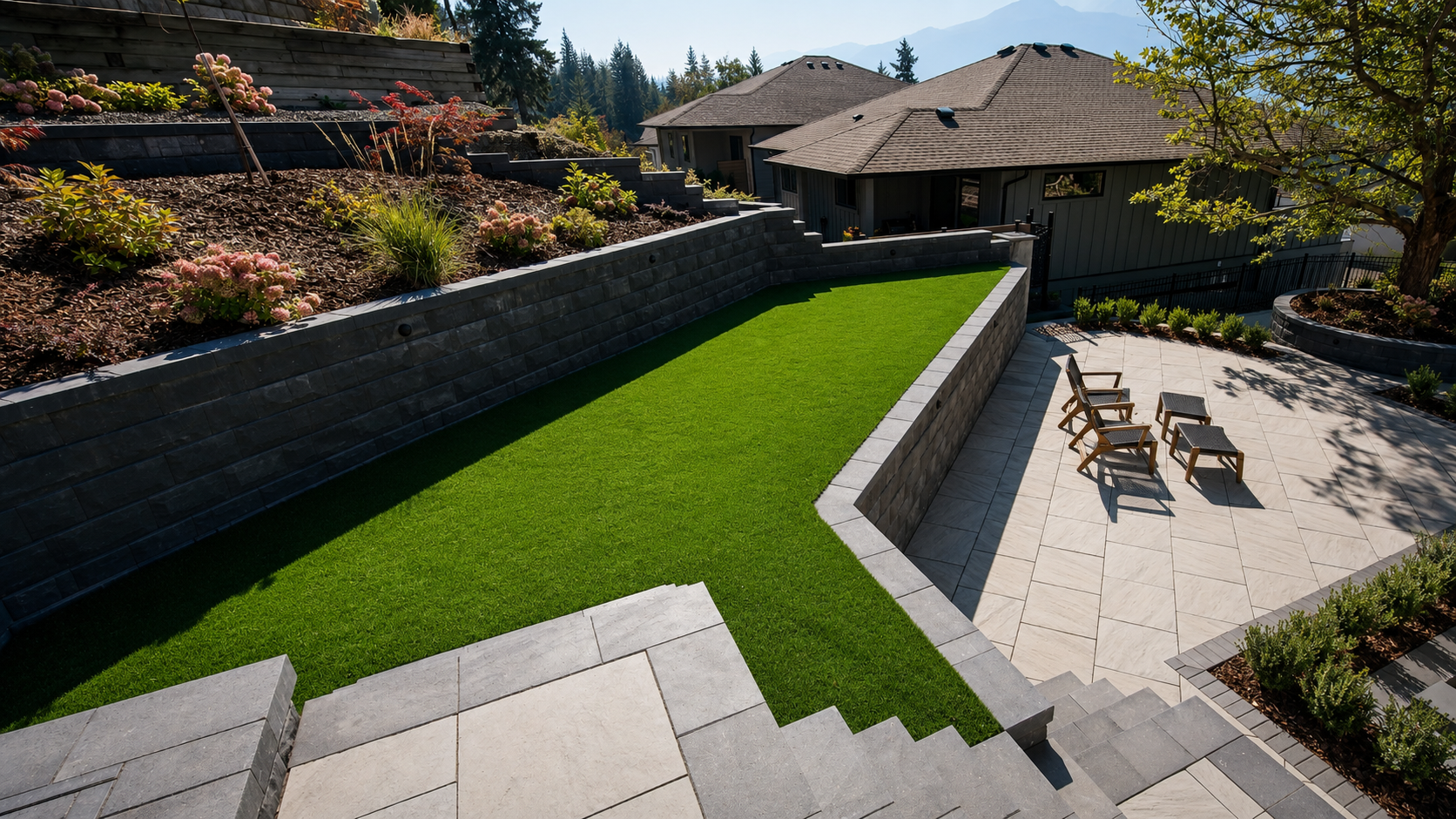
Retaining Wall Repair vs. Replacement: How to Tell Which You Need
A leaning or cracking wall doesn’t always mean a full rebuild — but sometimes it does, and the difference usually isn’t obvious from the driveway. Here’s what actually separates a repair from a replacement, and what a real inspection checks before anyone gives you a number.
Signs a Repair Is Enough
Most walls don’t fail all at once. If the wall is still structurally sound — standing plumb, not visibly shifting — these issues are usually addressable without tearing it out:
Hairline or vertical cracking in a poured or block wall, with no corresponding lean. Concrete cracks; the question is whether it’s cosmetic or structural, which is exactly what an inspection is for.
A single bulging course in an otherwise straight block wall, often from one section losing backfill compaction rather than the whole wall failing.
Efflorescence or minor water staining without active erosion behind the wall — usually a drainage tune-up, not a rebuild.
Loose or missing cap stones on an otherwise sound wall — a cosmetic and safety fix, not a structural one.
Signs You’re Looking at a Full Replacement
These are the signs that mean the wall itself — not just its face — has failed:
Visible lean of more than roughly 2–3 inches out of plumb over the wall’s height, especially if it’s worsened since you last checked.
No drainage system at all behind an older wall — a common issue on walls built before drainage requirements were standard practice, and one that will keep causing failures no matter how many times the face is patched.
A DIY or dry-stack wall now holding back more than it was built for — often from added fill, a new patio above it, or simply years of freeze-thaw cycles working the stones loose.
Waterfront walls losing ground to wave action — on Okanagan lakefront property, this is rarely a patch job; it’s usually an engineering and permitting question from the start.
What a Real Inspection Actually Checks
A lot of the uncertainty homeowners feel here isn’t really about the wall — it’s about not knowing who to call or trusting the quote once they do. A patch job priced high enough to make a small job go away, or a quote that never explains what’s actually wrong, doesn’t answer the real question.
A real inspection looks at the wall’s plumb line top to bottom (not just where it’s visibly bulging), what’s driving the movement — hydrostatic pressure, soil type, root intrusion, or a failed footing — and whether the drainage behind the wall exists and still works. That determines whether the fix is facing repair, a partial rebuild of the failed section, or a full replacement engineered for what’s actually uphill of it.
Every Kalagan estimate on an existing wall starts with this inspection, in writing, before any number gets attached to a repair or a rebuild.
Okanagan-Specific Factors That Tip the Decision
Freeze-thaw cycles. The Okanagan’s winter freeze-thaw swings are hard on older mortar joints and undrained backfill — a wall that was fine five years ago can develop real movement after a few harsh winters, even with no other change to the site.
Hillside lots. Sloped and view-oriented properties, common throughout Kelowna, West Kelowna, and Vernon’s bench neighbourhoods, put more load on retaining structures than a flat lot ever will — which is also why terracing gets suggested as a DIY alternative to one tall wall. Terracing can work well for smaller grade changes; it isn’t a substitute for a properly engineered wall once height, soil, or a waterfront setting are in play.
Waterfront and foreshore property. Walls along Okanagan Lake, Kalamalka Lake, or Skaha Lake fall under BC’s Riparian Areas Regulation, which affects what can be repaired versus what needs a redesign — see our shoreline design guide for how that regulation shapes waterfront wall decisions.
See Real Retaining Wall Rebuilds

Not Sure Which One You Need?
Get a real, in-person inspection — no guesswork, no go-away pricing.
Request an Inspection →