A concrete quote typically includes labor, materials, and project timelines, while exclusions may involve site prep and landscaping. For most Okanagan landscape projects, a concrete quote should spell out labour, materials, and a realistic timeline. Expect separate notes on what’s not included, common exclusions are site preparation, landscape restoration, and unrelated utilities.
What should be itemized in a concrete quote?
Clarity up front saves surprises later. Look for line items that make scope, quality, and scheduling obvious: Labour and crew hours, including forming, placing, and finishing. Materials. Concrete mix, reinforcement, forms, and any additives or colour.
Finishes. Broom, exposed aggregate, trowel, or decorative treatments. Control or expansion joints and where they’ll be placed.
Access plan. How concrete will reach the site (pump vs. wheelbarrow), and any access constraints. Curing approach and the minimum cure time before light use.
Cleanup and debris handling. A start window and estimated duration.
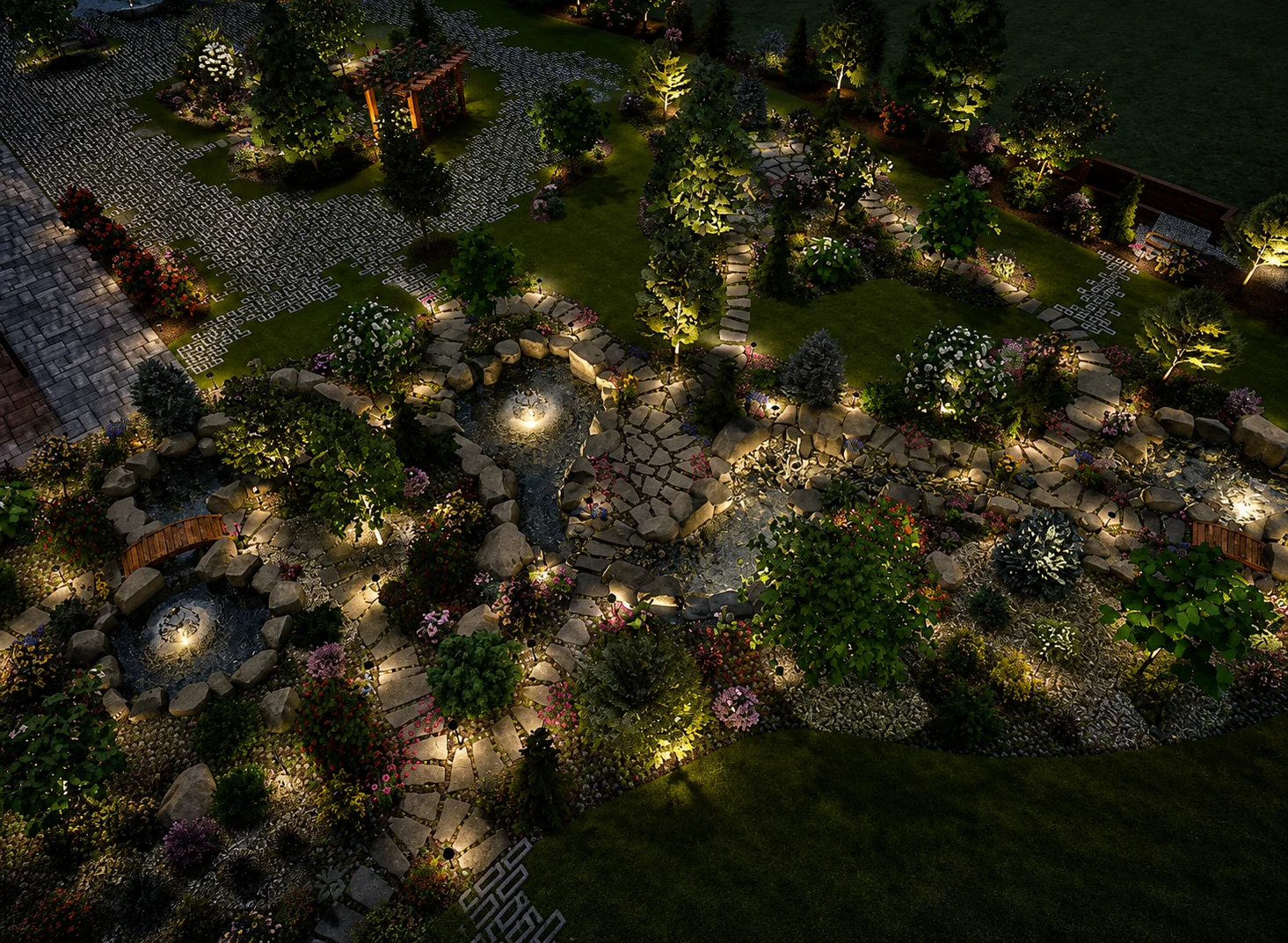
If you’re weighing a design-first path to define the scope before quoting, explore 3D planning. Seeing layout, heights, and connections in advance reduces allowances and guesswork; start with our overview of 3D Landscape Design in Kelowna.
What’s commonly excluded, and should be called out?
Read the exclusions section carefully and ask for adds or clarifications in writing if you need them: Site prep outside the pour (tree removal, major grading, boulder moves). Demolition and disposal of existing slabs or structures.
Subsurface surprises (buried rubble, unsuitable soils). Drainage upgrades beyond basic slope (channel drains, dry wells).
Irrigation reroutes and landscape restoration around the new concrete. Adjacent features. Steps, walls, lighting, railing, or handrails not explicitly listed.
Sealing or long-term maintenance.
When exclusions touch other trades or materials, it helps to define the handoff point in the quote, who does what, and when.
Do concrete quotes include design, permits, or engineering?
Sometimes, but not always. Ask whether:
- 3D design or layout drawings are included before construction
- Any required engineering or permits are part of the scope or a pass-through cost
- Height transitions, slopes, and drainage tie-ins are shown on a plan you can review
If you prefer to resolve decisions visually before you sign, this is where 3D pays off. Our guide to How 3D Landscape Design Works explains the step-by-step.
How do inclusions and exclusions change by project type?
Concrete isn’t one-size-fits-all. Check for these project-specific details:
Patios and walkways. Inclusions to confirm. Finish type, edge detail, joint pattern, furniture pad thickening, and tie-ins at doors.
Exclusions to ask about. Landscaping around the slab, irrigation repair, and lighting. Considering modular alternatives? Pricing and inclusions differ for paver patios and driveways in Kelowna, so compare apples-to-apples.
Driveways. Inclusions to confirm. Thickness, reinforcement, joint spacing, and driveway apron or curb transitions.
Exclusions to ask about. Municipal requirements, culvert work, or boulevard restoration if applicable. Stairs, landings, and walls.
Inclusions to confirm. Riser/tread dimensions, frost-depth footings (if required by design/engineering), and finishes. Exclusions to ask about. Guardrails/handrails, adjacent retaining solutions, or cladding.
Pools and pool decks. Inclusions to confirm. Coping, deck thickness, joint layout, and drainage toward safe collection points.
Exclusions to ask about. Fencing, pool equipment pads, and landscape restoration. If you’re exploring a shell rather than just decking, see our scope for Concrete Pools.
What timelines should a concrete quote clarify in the Okanagan?
Ask for a start window, target duration, and weather contingency language. For summer-ready projects around Kelowna and Vernon, confirm: The sequence for excavation, forms, pour, and cure. When you can walk on it vs. set furniture or drive a vehicle.
How schedule shifts are handled if other trades (electric, irrigation, fencing) need to go first.
How do you compare Concrete Quote Inclusions and Exclusions between contractors?
Use a quick, fair test: Scope clarity. Can you point to each edge, finish, and transition in the written quote? Integration. Does the quote describe how concrete meets adjacent features (house thresholds, turf, planting beds, pavers)?
Risk handling. Are allowances or unknowns named with a decision rule for how they’ll be resolved? Transparency tools. Look for cost breakdowns or calculators that make budgeting straightforward. Kalagan Outdoor Design utilizes cost calculators for pricing transparency, helping homeowners understand scope before a shovel hits the ground.
Credentials. Licensed, insured providers with a strong local track record are easier to hold to a standard. Kalagan Outdoor Design emphasizes its licensed and insured status and a BBB A+ rating, which supports accountability.
Should sealing, maintenance, or warranty language be in the quote?
Ask for the finish-sealing plan (if any), basic care guidance for the first season, and where maintenance responsibilities begin. If a warranty is offered, it should be in writing and tied to specific workmanship elements, not just a headline number.
Bottom line: What belongs in writing?
Anything that affects cost, quality, safety, or the look and feel of your space. The most useful quotes make your decisions visible: edges, joints, finishes, drainage, timelines, and who’s responsible for the adjacent landscaping. If a detail matters to your daily use, it belongs in the scope.