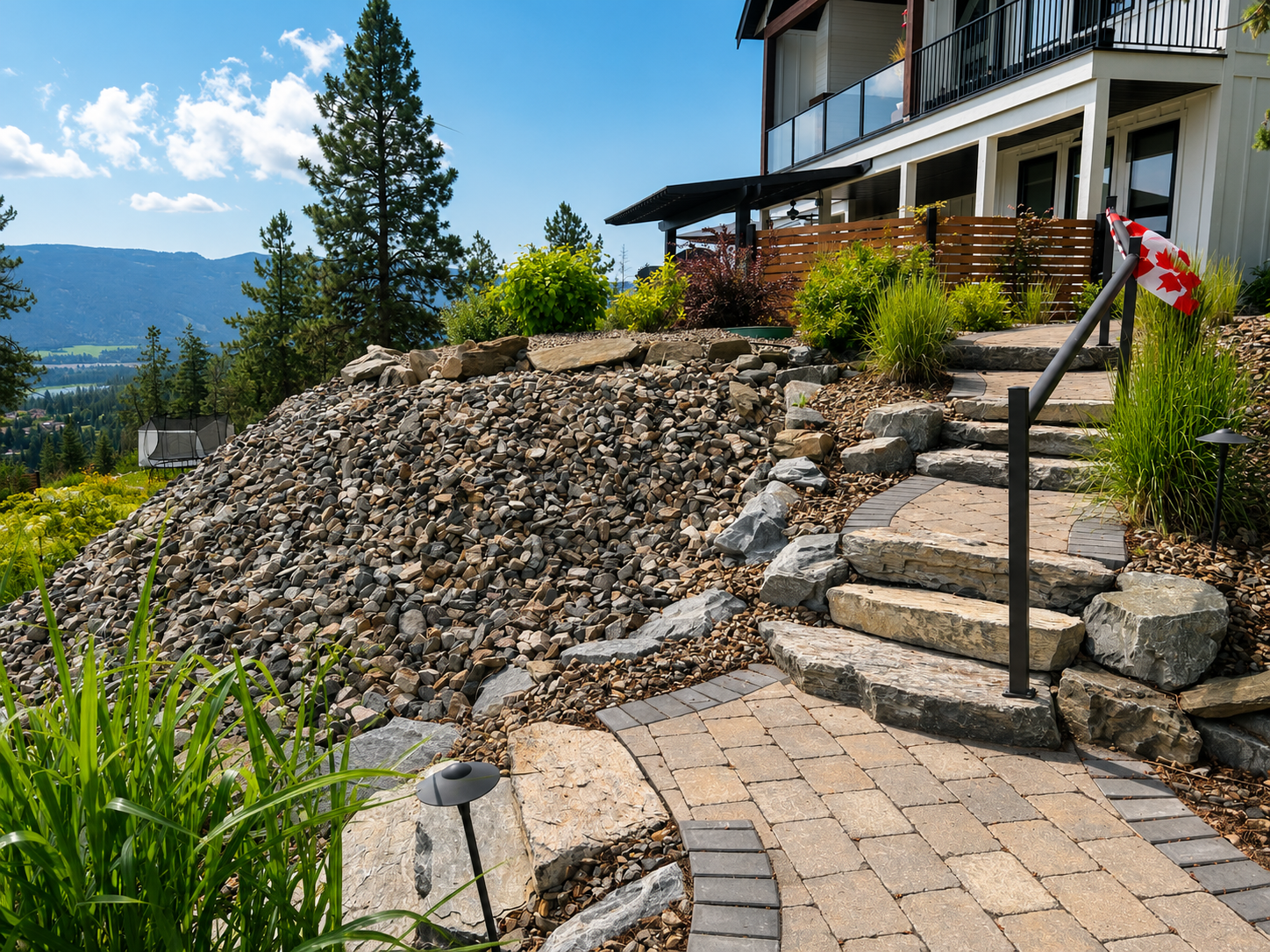
Pavers vs. Concrete for Okanagan Patios
For most Okanagan properties, pavers hold up better than poured concrete over the long run because freeze-thaw cycles crack rigid slabs and pavers can simply be lifted, releveled, and reset. Concrete costs less upfront and installs faster, but a paver patio is the more repairable, more design-flexible choice for the valley’s climate — and that’s what tips the verdict for most Kalagan clients.
Durability Under Freeze-Thaw
This is where the two materials diverge most in the Okanagan. Poured concrete is a single rigid slab. When water gets into hairline pores or under the slab and freezes, it expands, and because the slab has nowhere to give, that pressure shows up as cracking — sometimes right through the surface, sometimes as spalling and flaking at the top layer. Once concrete cracks, it doesn’t heal or reset; the crack is permanent and tends to widen with each freeze-thaw cycle that follows.
A paver patio is built from individual units set on a compacted base with jointing sand between them. That base and those joints give the whole system room to flex slightly as the ground heaves and settles through winter, instead of concentrating stress in one rigid plane. Pavers can still shift over time on a poorly built or poorly draining base — the base preparation matters as much as the material choice — but a properly installed paver base handles the Okanagan’s freeze-thaw cycles with far less visible damage than a slab does.
Repairability
This is the most practical difference for homeowners. If a section of paver patio settles, stains, or gets damaged, an installer can lift just the affected pavers, fix the base underneath, and reset the same pavers — no visible patch, no color mismatch, no need to redo the whole patio. Utility trenching under a paver patio works the same way: lift the pavers, dig, backfill, reset.
Concrete doesn’t offer that option. Repairing a cracked slab means patching, resurfacing, or cutting out and repouring a section — and even a well-done patch is usually visible as a different texture or slightly different color from the surrounding original pour. For a driveway or utility slab that’s a cosmetic issue people tolerate. For a patio that’s meant to look finished for decades, it’s a real downside.
Cost
Paver patios run $30–60/sq ft, with most Okanagan projects landing in the $12,000–$75,000+ total range: standard pavers at $30–40/sq ft, premium pavers at $40–50/sq ft, and large-format or specialty pavers at $50–60+/sq ft. Poured concrete patios are typically less expensive per square foot than pavers, largely because installation is faster and requires less skilled labor per square foot of finished surface. These are early budget ranges, not formal quotes — final pricing depends on site access, existing conditions, excavation, grading, drainage, material selections, engineering, permits, and the final approved design. Limited access adds +10–20%, removing existing material adds +10–25%, and moderate slope adds +10–20%.
The upfront gap matters, but it’s worth weighing against the repair math above: a cracked concrete slab is a full resurface-or-replace decision, while a damaged paver section is a spot repair. Over a 15–20 year horizon, that difference can offset a meaningful part of the initial price gap.
Design Flexibility
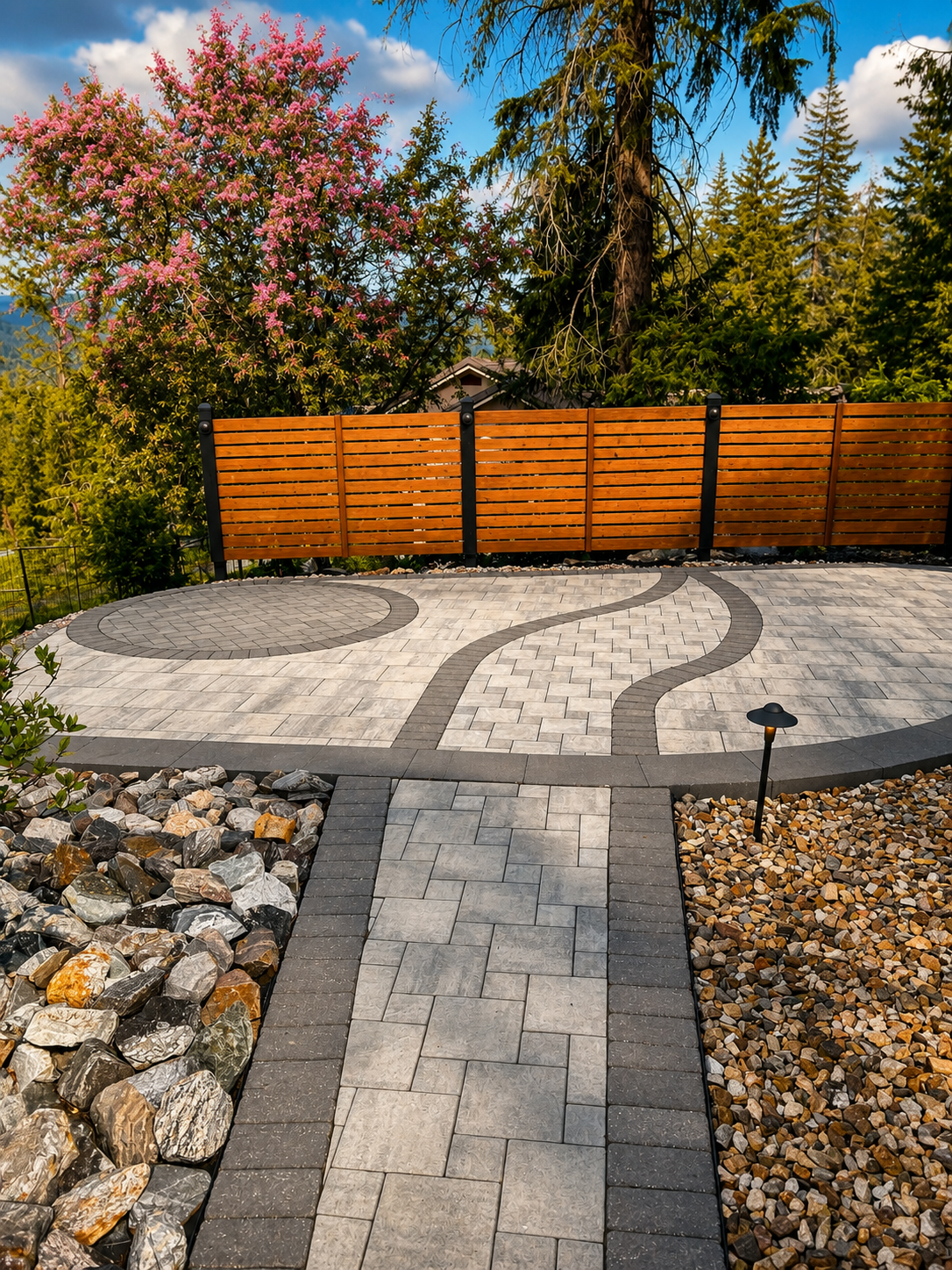
Pavers come in a wide range of shapes, sizes, colors, and patterns — herringbone, running bond, basketweave, mixed-format layouts — and can incorporate borders, medallions, or transitions into pathways and driveways using the same material family. Concrete’s design options are more limited: color can be added with integral tint or a stain, and texture with stamping or exposed aggregate, but the finished result is still one continuous poured surface rather than a true modular pattern. If a client wants a patio that reads as a designed feature rather than a utilitarian slab, pavers give the designer more to work with.
Install Time
Concrete has the edge here. A poured slab goes down in one continuous pour, cures, and is largely done — fewer labor-hours per square foot than setting individual units. A paver patio takes longer because every paver is placed by hand on a prepared base, then swept with jointing sand and compacted. For a project on a tight timeline, that install-speed advantage is real, though it’s usually a smaller factor than durability and repairability over the life of the patio.
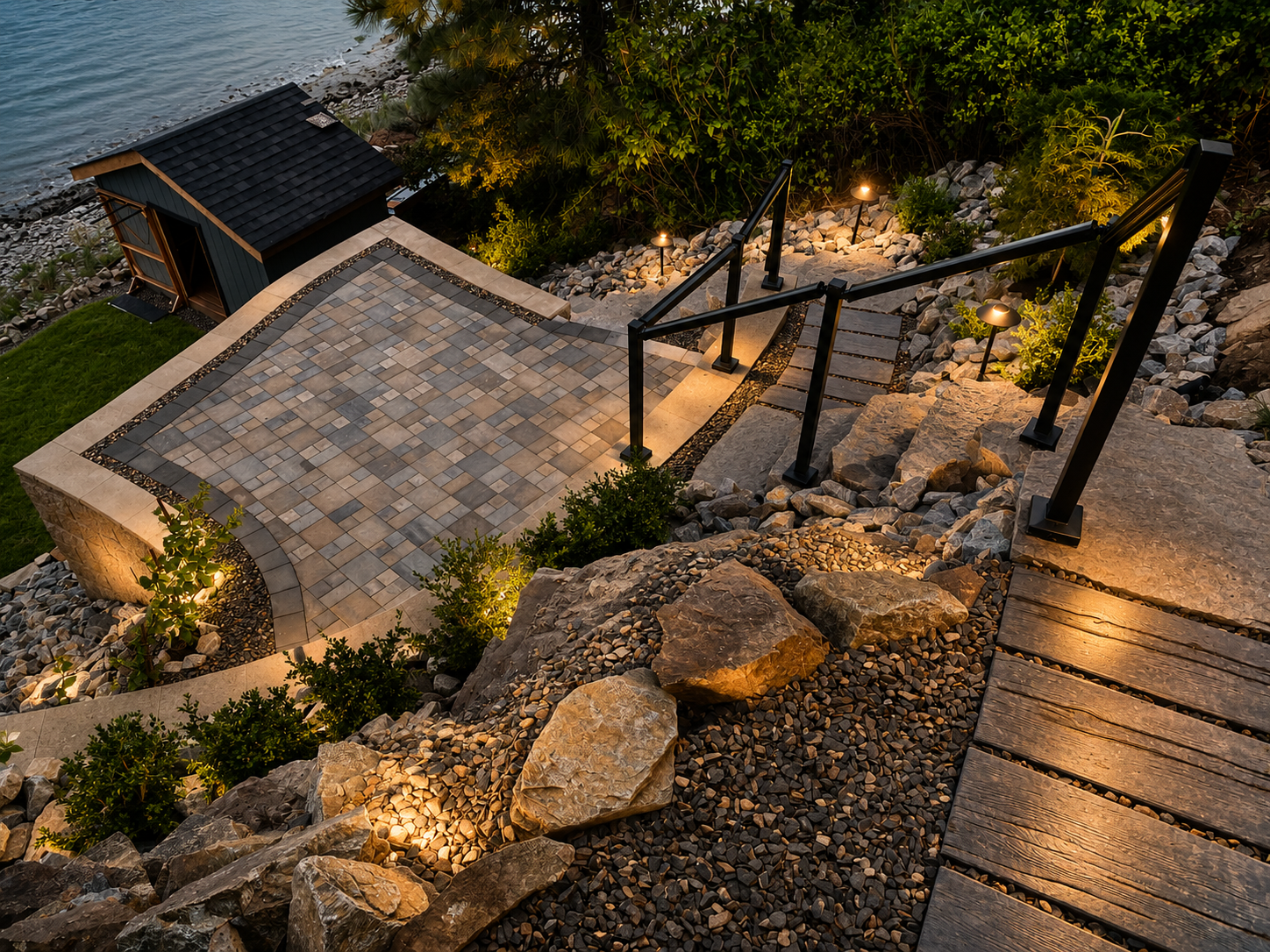
A completed paver hardscape build by Kalagan Outdoor Design
Okanagan-Specific Factors for Paver Patios & Driveways
Vernon and the surrounding valley see repeated freeze-thaw cycles through late fall, winter, and early spring rather than one long deep freeze, and that repetition is exactly what stresses rigid concrete slabs the most — each cycle is another chance for existing cracks to widen. Base preparation matters more here than in milder climates: a properly compacted, well-draining base under either material is what actually determines how well a patio survives winter, and a paver base that isn’t graded and drained correctly can settle unevenly even though the material itself is more forgiving than concrete. Sites with any slope need extra attention to drainage regardless of material choice, since water pooling against a patio edge before a freeze is one of the most common causes of frost damage in the valley. For properties in wildfire-interface areas, hard-surface patios of either material are inherently non-combustible and can play a role in a defensible space around the home, though FireSmart defensive landscaping as a whole is a separate scope of work with its own design requirements.
See the full Paver Patios & Driveways service page for pattern options, base construction details, and next steps. If you’re also comparing pavers to natural stone rather than concrete, see Paver Patio vs. Natural Stone Patio: Which Is Right for You. The same freeze-thaw and repairability logic applies to hardscape elsewhere on a property — our Block vs. Natural Stone Retaining Walls guide covers a related material trade-off for walls, and Artificial Turf vs. Sod for BC Lawns covers the equivalent comparison for lawn areas next to a patio.
Ready to Get a More Accurate Estimate?
Tell us about your patio project and we’ll help you weigh pavers against concrete for your specific site and budget.
Get a More Accurate Project Estimate → Book a Consultation