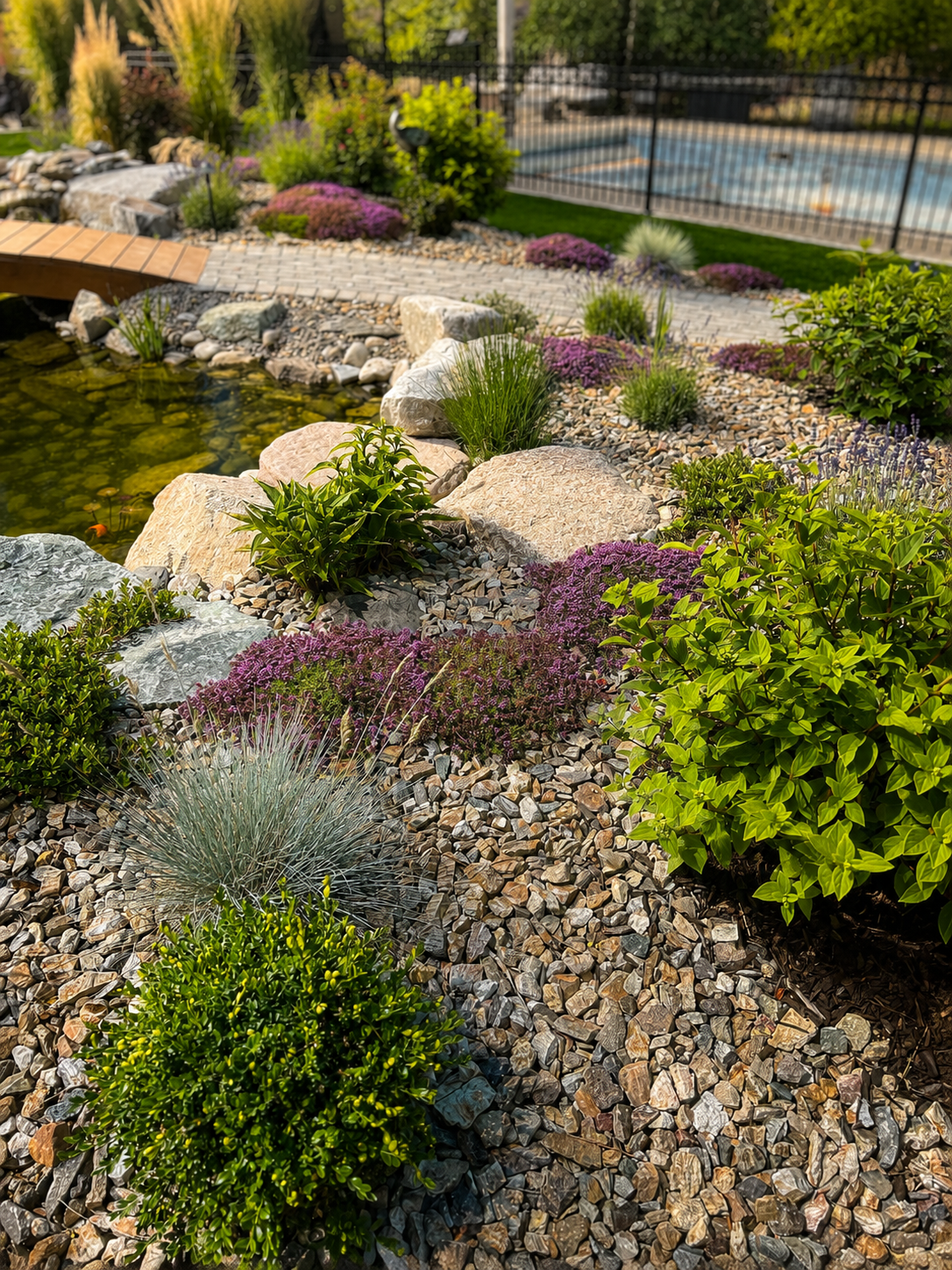
50 Drought-Tolerant Plants for the Okanagan
The Okanagan’s semi-arid climate, hot summers, and water restrictions make drought-tolerant planting less of a style choice and more of a practical necessity. Below is a real, working list of proven low-water perennials, grasses, shrubs, and groundcovers for Vernon, Kelowna, and the surrounding valley — organized by category with growing notes for each.
Succulents & Groundcovers
These form the backbone of a low-maintenance xeriscape bed — spreading, drought-proof, and effective at suppressing weeds once established.
- Stonecrop (Sedum spp.) — Low varieties like ‘Dragon’s Blood’ and ‘Angelina’ spread as a dense mat; taller upright types like ‘Autumn Joy’ work as border plants. Thrives in poor, rocky soil.
- Hens and chicks (Sempervivum spp.) — Rosette-forming succulent, ideal for rock gardens, retaining wall crevices, and containers. Essentially indestructible once rooted.
- Ice plant (Delosperma spp.) — Vivid summer flowers over a low, ground-hugging mat. Best on a sunny slope with sharp drainage.
- Creeping thyme (Thymus serpyllum) — Fragrant, foot-traffic-tolerant groundcover that works well between pavers or as a lawn alternative on a small scale.
- Snow-in-summer (Cerastium tomentosum) — Silvery foliage and white spring flowers; spreads quickly on dry, sunny banks.
- Kinnikinnick / bearberry (Arctostaphylos uva-ursi) — A true BC native groundcover, evergreen, and exceptionally drought- and heat-tolerant once established.
Perennials
The flowering backbone of a drought-tolerant border — most of these are Mediterranean or prairie natives that expect hot, dry summers.
- Lavender (Lavandula angustifolia, ‘Munstead’, ‘Hidcote’) — The signature Okanagan xeriscape plant. Needs full sun and excellent drainage; overwatering kills it faster than drought does.
- Russian sage (Perovskia atriplicifolia / Salvia yangii) — Silvery, airy foliage with long-blooming purple spikes; tolerates poor soil and reflected heat off pavers or stone.
- Yarrow (Achillea millefolium and hybrids) — Flat flower clusters in yellow, red, or pastel shades; extremely drought-hardy once established, including the native form.
- Purple coneflower (Echinacea purpurea) — Long-blooming, pollinator-friendly, and tolerant of dry spells once its root system is in.
- Black-eyed Susan (Rudbeckia fulgida) — Reliable summer-into-fall colour; handles heat and dry soil far better than a manicured lawn.
- Blanket flower (Gaillardia aristata) — A genuine BC-interior native with red-and-yellow blooms all summer; thrives in poor, gravelly soil.
- Catmint (Nepeta x faassenii) — Long-blooming purple-blue spikes, useful as a low border plant; deer generally leave it alone.
- Sage (Salvia nemorosa and Salvia officinalis) — Ornamental salvias handle heat and drought while providing strong vertical texture and long bloom time.
- Sea thrift (Armeria maritima) — Compact, grass-like foliage with pink pom-pom flowers; good for edging and rock gardens.
- Lamb’s ear (Stachys byzantina) — Soft silver foliage that thrives in poor, dry soil and full sun.
- Sedum spectabile (showy stonecrop) — Larger upright sedum with late-season flower heads that feed pollinators into fall.
- Penstemon (Penstemon spp.) — Native and hybrid varieties both perform well on dry, sunny slopes with good drainage.
Ornamental Grasses
Grasses add movement and winter structure while using a fraction of the water a lawn needs. See our companion guide on ornamental grasses for xeriscape design for a deeper dive.
- Feather reed grass (Calamagrostis x acutiflora ‘Karl Foerster’) — Upright, narrow habit with tall seed plumes; one of the most widely used structural grasses in Okanagan xeriscapes.
- Blue fescue (Festuca glauca) — Compact, steel-blue clumping grass, excellent for edging and mass planting in rock gardens.
- Little bluestem (Schizachyrium scoparium) — Native prairie grass with blue-green summer colour that turns copper-red in fall.
- Switchgrass (Panicum virgatum) — Tall, airy, and deep-rooted; handles heat, drought, and Okanagan winters well.
- Blue oat grass (Helictotrichon sempervirens) — Silvery-blue clumping grass that holds its form through winter.
- Fountain grass (Pennisetum alopecuroides) — Arching habit with bottlebrush flower plumes; performs best in a hot, sunny bed.
Shrubs
Shrubs provide the structure and mass of a xeriscape design, and several of the best choices are natives already adapted to the valley’s dry hillsides.
- Junipers (Juniperus horizontalis, J. scopulorum, and other cultivars) — Evergreen, low-water, and available in spreading, mounding, or upright forms for nearly any spot in the design.
- Smooth sumac (Rhus glabra) — Native shrub with brilliant fall colour and a spreading habit; excellent on dry banks and slopes.
- Potentilla (Potentilla fruticosa) — Compact native shrub with a long bloom season in yellow, white, or orange; very cold- and drought-hardy.
- Caragana (Caragana arborescens) — Extremely tough prairie shrub/small tree, used widely as a windbreak and dry-site hedge in the BC interior.
- Cotoneaster (Cotoneaster spp.) — Spreading or upright forms with small flowers, berries, and strong drought tolerance.
- Spirea (Spiraea japonica and hybrids) — Reliable flowering shrub that tolerates heat and dry spells once rooted in.
- Buffaloberry (Shepherdia canadensis / S. argentea) — Native to the BC interior’s dry slopes; silvery foliage and strong drought resilience.
- Sagebrush (Artemisia tridentata) — The classic Okanagan bunchgrass-and-sage landscape shrub; needs sharp drainage and full sun.
- Rabbitbrush (Ericameria nauseosa) — Native to the dry benches of the valley, with silvery foliage and late-season yellow bloom.
- Rugosa rose (Rosa rugosa) — Tough, disease-resistant shrub rose that handles dry, sandy soil far better than hybrid tea roses.
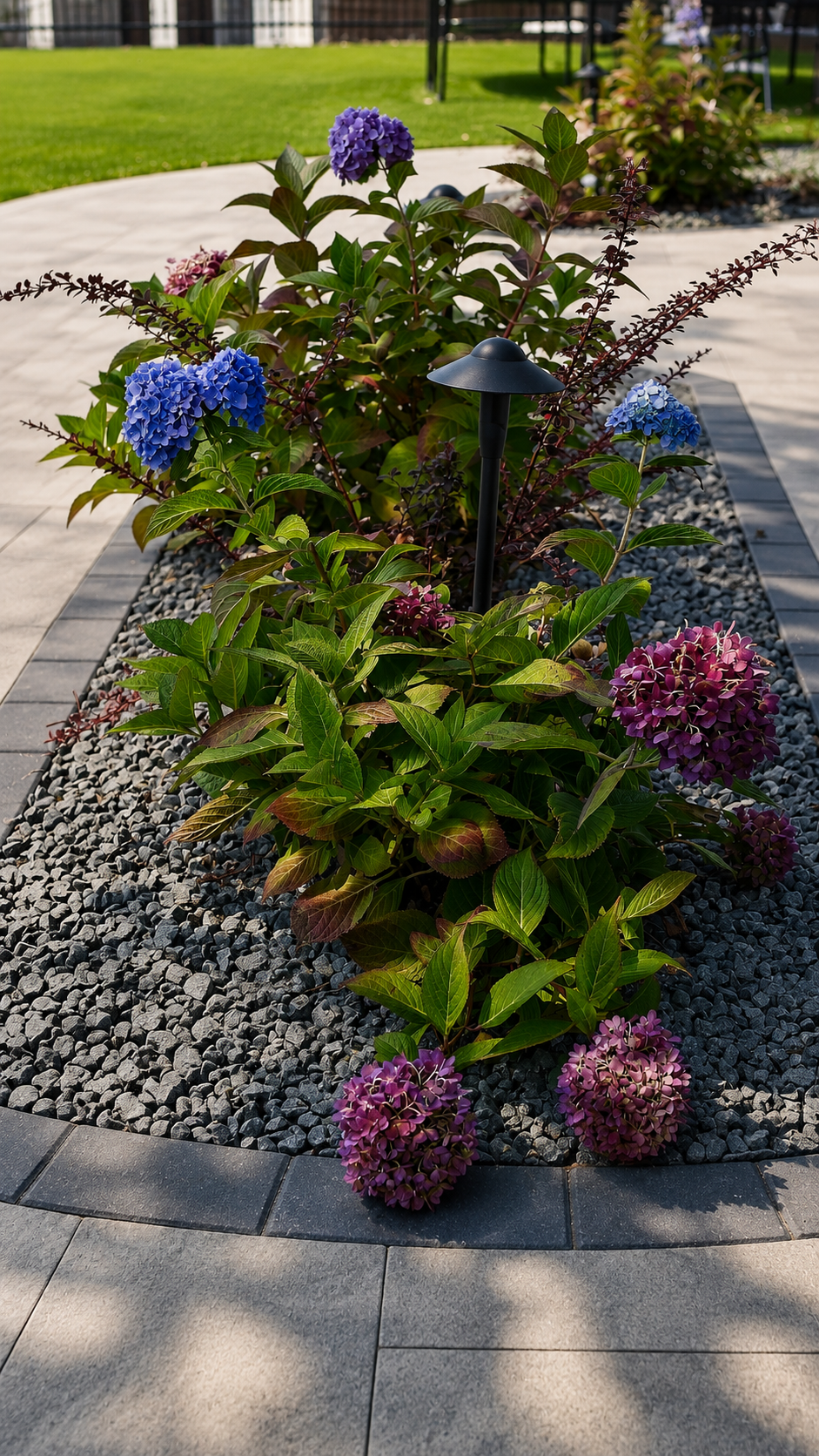
A finished planting bed by Kalagan Outdoor Design
Okanagan-Specific Factors for Planting & Xeriscape Design
The Okanagan Valley sits in one of Canada’s driest climate pockets, generally falling in USDA hardiness zones 5-6b depending on elevation and proximity to the lake, so every plant on this list has to survive both a hot, dry summer and a genuinely cold interior winter. Water restrictions in Vernon, Kelowna, and surrounding municipalities during peak summer months make low-water plant selection a practical way to keep a landscape looking good without relying on daily irrigation. Hillside and bench properties — common throughout the valley — also drain fast, which actually favours these species since most drought-tolerant plants fail from soggy roots long before they fail from underwatering. In properties near the wildland-urban interface, several of these same species (junipers being the notable exception) also fit well into a FireSmart-conscious planting plan when spaced and maintained correctly; see our FireSmart Defensive Landscaping service for guidance on fire-conscious plant placement. Regardless of species, the first one to two growing seasons after planting still require regular watering to establish a deep root system — drought tolerance is a long-term payoff, not an immediate one.

This list pairs naturally with our full Xeriscaping & Planting Design service, where we turn a plant palette like this into a complete, professionally graded landscape. If deer pressure is a concern in your neighbourhood, cross-reference this list against Deer-Resistant Perennials for Vernon. For structural planting beyond perennials, see Zone 5 Native Shrubs for the Okanagan and Ornamental Grasses for Xeriscape Design.
Ready to Design Your Drought-Tolerant Landscape?
Get a sense of what a full xeriscape conversion costs for your property, or book a consultation to talk through a plant palette suited to your site.
Get a More Accurate Project Estimate → Book a Consultation